Job confirmed: The First Session
5 Tips for both Parents and Tutors The first moments for any new tutoring assignment can be a nervy affair, for both parent and tutor, and more importantly the tutee!

post
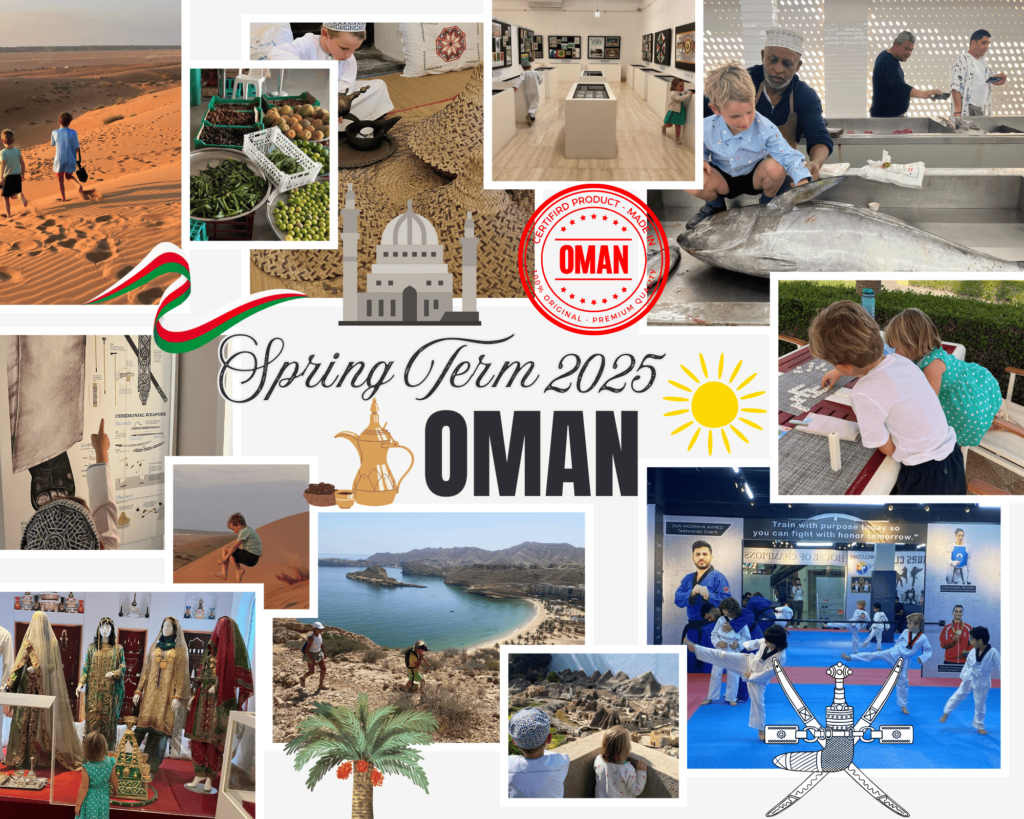
Between April 2024 and December 2025, my family took the decision to spend the Spring Term in Muscat, Oman, with our two young children (age 4 and 7) enrolled at an international school. Whilst the location was driven by my husband’s work, when the opportunity arose to spend 4 months overseas, I jumped at it. Friends and colleagues were divided in their reaction – some quietly admiring of us doing something different; others baffled by the logistical challenge and upheaval. So, why did we do it, and what did we gain from it?
We may all have different ideas on how to define an optimal education. As a parent however, I believe we can all agree on a shared desire to foster a love of learning in our children. After all, children who love learning go further and stay inquisitive for longer. Adventure travel formed a major part of my childhood and I credit that (and my parents) for my globally curious and inquiring mind today, on top of the happiest of memories. When we are genuinely curious about something, our brains release dopamine – the same neurotransmitter involved in other rewarding experiences. This creates a positive cycle: curiosity leads to exploration, which leads to discovery, which triggers more dopamine which makes us want to keep going. From the year they were born, my husband and I have chosen to take every opportunity we can to travel with our children, hoping to broaden their minds and build a global outlook. We wanted them to see intelligence and learning as a natural human behaviour – a constant, intrinsic part of life – rather than something confined to a sterile 4-walled classroom, or something reserved for “smart people”.
If we want young people to thrive in an uncertain and complex world, then I believe we need to feed them experiences that will nurture their resilience, curiosity and joy, as well as their knowledge. Spending a school term in another country with a different culture, customs and language was an exciting way for us to offer this. From day one, the children were problem-solving in new ways, constantly introduced to new perspectives and considering daily concepts from different angles. We could visibly see the experience sparking all sorts of new connections and developing their critical thinking skills. After all, authentic learning is not confined to books or exams, but is a living, breathing dialogue between people, places and possibility. It provides an opening into the wider interconnected world we share.
My son (previously a reluctant writer) kept a travel journal which he voluntarily wrote in most nights, documenting his experiences. He was no longer associating writing as a boring classroom exercise. His journal was a safe, creative space for him to make imaginative connections and reflect on this exciting chapter of his life. In turn, his reading skills also soared. So often, hating a school subject doesn’t mean you hate learning – you might just hate how you’ve been taught that subject.
It goes without saying that the cultural enrichment from the trip was impactful. Both children learned basic Arabic and immersed themselves on a daily basis in local culture, attending Iftar events during Ramadan and celebrating Eid with local families. We had 9 different nationalities attend our children’s joint party, and the children were fed upon a daily diet of ideas fuelled by multicultural diversity, religion and cuisine. The kids’ school houses 66 different nationalities so each week there was a new cultural event for the children to celebrate (and pack lunches were diverse!).
Beyond academics, the children developed new hobbies outside of school at local clubs from Tae Kwondo to bouldering and skateboarding. With guaranteed fair skies and the school day starting and finishing early, we capitalised on the opportunity to major on extra sport. The children excelled in tennis, football, swimming and golf, all done via clubs and coaching outside of school. I would argue there are few better ways to mindfully start your work day, and the kids start their school day, than to take your children out on a paddleboard before breakfast as they gaze down at the marine life below.
Weekends were spent inadvertently learning about climate and landscape whilst camping in the “sugar dunes”, hiking in the Jebel Akhdar and visiting remote mountain villages. Walking along ancient irrigation channels (falaj), we discussed the value of water, where it comes from, where it goes and its agricultural importance. The children were actively engaged, seeing it and living it, not yawning in the back of a classroom. My son stumbled across a washed-up dead turtle on a beach, with a bellyful of plastic, having been swimming with turtles a few days prior. An algae bloom turned our favourite swimming spot into a soupy sludge that Winnie the Witch would have been proud of. Environmental concerns had become their “lived reality”, not a detached concept on a documentary. The colour and variety of their daily education, both within and outside of school, felt tangible and meaningful.
Buying our food produce directly from local fishermen and farmers, in contrast to the online food delivery back home, delivered a tangible lesson in food sustainability and origin. As a child, I always enjoyed learning because my parents helped me see the reason for it. When I felt disenchanted by a subject or topic, they plied me with real-life examples. Kids lack interest when they don’t see the point. They cannot relate it to anything in their world so it doesn’t feel worth it. It doesn’t feel that it matters. When learning is real, active, and at times practical, that’s when you want to drink it up. In our final week, my children were bestowed with local dress from some typically kind Omani friends (including a dishdasha, kumma and khanjar for my son, the latter being a traditional, J-shaped dagger), and wear these items with great pride.
One key reflection of the trip was the joy in sharing a new experience with the children. My husband and I were making new friends in real-time alongside the kids, sharing our newest discoveries, challenges and excitements. It was fresh, real and we were all in it together which made all the novelty less scary for the kids and bonded us ever-closer. As a suitable reminder of all the positive takeaways, the before and after photos spoke volumes as to the kids’ boost in general health. Even for the most active and outdoorsy families, keeping your children moving and outside is tricky to sustain during the vitamin-D starved British winter.
Especially these days with the academic system so focused on exam success, it has been a luxury to show our children that being intellectually curious doesn’t have to be one-dimensional, desk-based and dull. The term away will also have served as a CV-enriching exercise providing a compelling discussion point for future school interviews. For any families considering some time abroad with their children, I would urge them to go for it. It is experiences such as this that will help your children into well rounded, resilient and globally minded human beings who are arguably more future-ready than their peers. To me, that is the best education I can hope for my children to receive.
“Develop a passion for learning. If you do, you will never cease to grow.” Anthony J. D’Angelo
Read More
5 Tips for both Parents and Tutors The first moments for any new tutoring assignment can be a nervy affair, for both parent and tutor, and more importantly the tutee!
Written by Issac F, a secondary school Physics teacher at a distinguished London Grammar School and experienced Civil Engineer (BEng University of Bath). Please contact info@bespoketuition.com to view his full profile and request his
A post-Covid remedy to 2020’s education misadventure? “The pessimist complains about the wind. The optimist expects it to change. The realist adjusts the sails.“ WILLIAM ARTHUR WARD With travel off-limits